
Summary
- What happened: On November 17, 2026, Microsoft launched two coding models, MAI Code 2 and MAI Code 2 Flash, and made both available in GitHub Copilot.
- Why it matters: Microsoft says they come close to the top coding models at a fraction of the price, so picking a model per task is now a real cost decision.
- Do this now: Test the cheaper model on a week of your own real tasks and measure cost per finished change, not price per token.
AI Briefing · Microsoft MAI Code 2
On this page
- What is MAI Code 2?
- Why it matters: cheap coding help changes the math
- What to prepare for
- What we don't know yet
- Copy-and-paste prompt
- Limits
- FAQ
What is MAI Code 2?
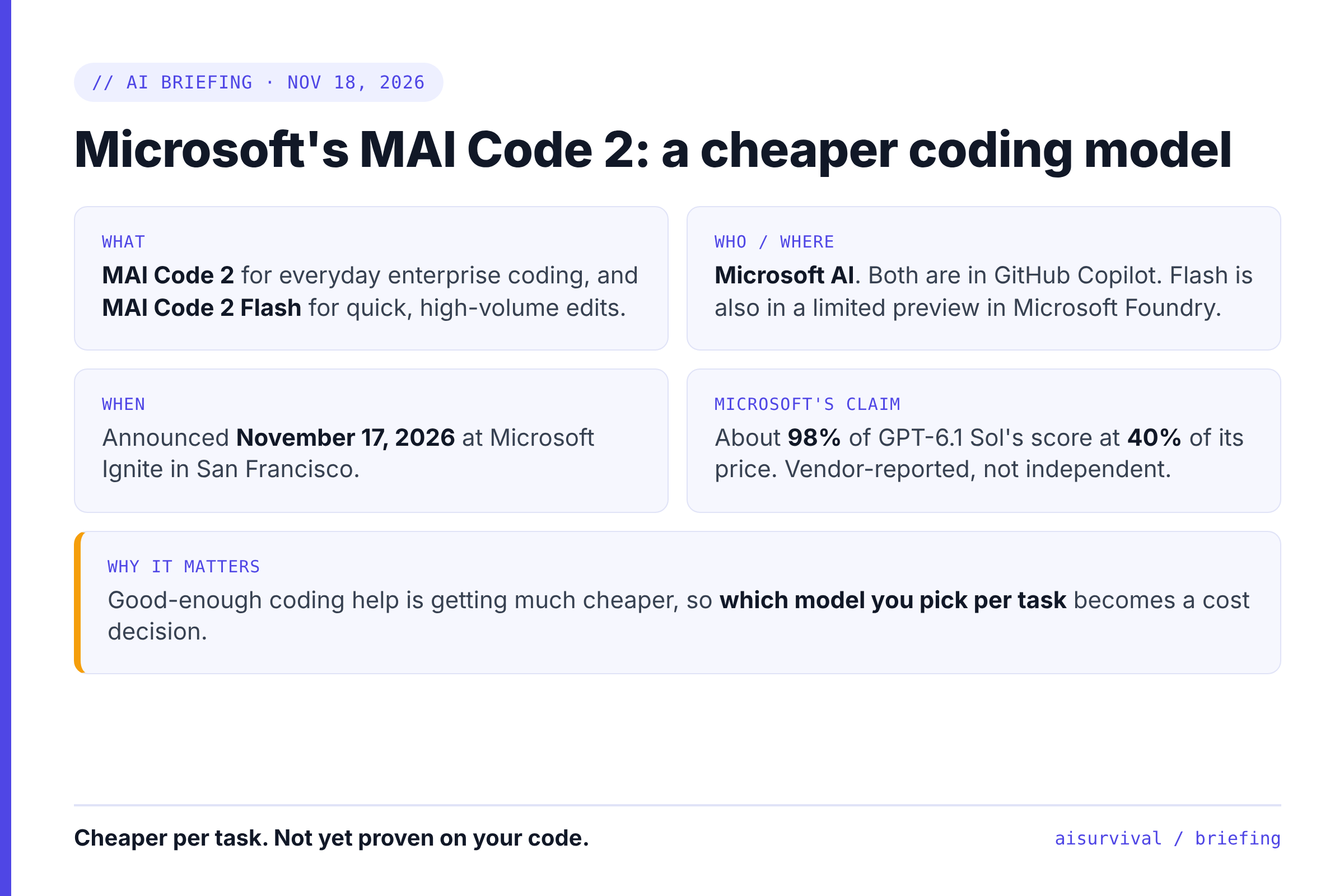
MAI Code 2 is a coding model built by Microsoft AI, the company's in-house AI lab, for everyday enterprise programming work. It launched with a smaller sibling, MAI Code 2 Flash, for quick, high-volume edits. Microsoft's pitch is not "best model ever." It's "almost as good, for much less money."
Here are the facts, as published on November 17–18, 2026:
- When and where: Microsoft announced the models on November 17, 2026, at its Ignite conference in San Francisco (Reuters, via The Star).
- What each one is for: MAI Code 2 targets everyday enterprise coding. Flash targets high-volume tasks like code explanations, targeted edits, and routine fixes (Microsoft AI).
- Where you can use them: Both are in GitHub Copilot. Flash is also in a limited access preview in Microsoft Foundry, Microsoft's platform for building apps on AI models (Microsoft AI).
- Microsoft's quality claim: MAI Code 2 "gives you 98% of the performance of GPT-6.1 Sol at 40% of the price," averaged across four coding benchmarks (tests that score models on set tasks). Microsoft also puts it at about 96% of Claude Opus 5.5's performance at about 5% of the cost (Microsoft AI).
- What it's not for: Microsoft says the models aren't yet tuned for fundamental science research or very long, multi-step agent work (Microsoft AI).
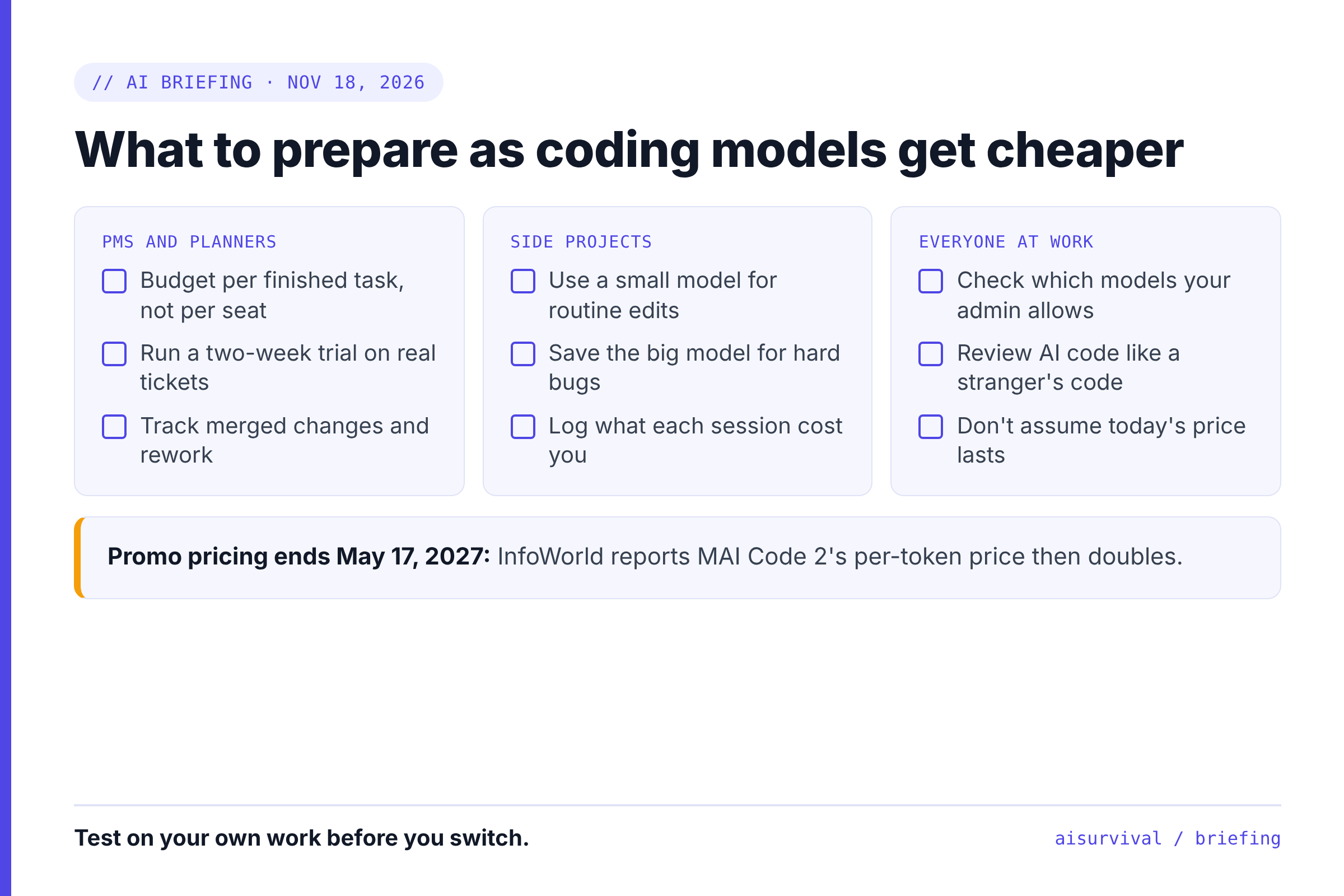
- Price, as reported: InfoWorld, citing GitHub's pricing page, reports a promotional rate for MAI Code 2 of $0.50 per million input tokens and $2.50 per million output tokens through May 17, 2027. After that, InfoWorld says it rises to $1.00 and $5.00 (InfoWorld). A token is a small chunk of text, roughly part of a word.
Why it matters: cheap coding help changes the math
Everything in this section is our analysis, not something Microsoft said.
"Good enough" is now a budget line
Microsoft's own per-task figures, reported by InfoWorld, put MAI Code 2 at $0.309 per task against $6.306 for Claude Opus 5.5. That's $0.309 ÷ $6.306 ≈ 4.9%, which matches Microsoft's claim of about 5%. If most of your coding requests are routine, paying top-model prices for all of them starts to look like a choice, not a default.
The score gap is small, but not zero
In Microsoft's own benchmark table, MAI Code 2 averages 63.2%, behind GPT-6.1 Sol at 64.1% and Claude Opus 5.5 at 65.3% (InfoWorld). It wins some tests and loses others. A few points on a benchmark can still mean more rework on the hard tickets in your codebase.
Model cost is a small slice of total cost
Analyst Pareekh Jain told InfoWorld that if model use is 10% of development cost, cutting model cost by 60% saves only about 6% overall. The math: 10% × 60% = 6%. Review time, testing, and fixing AI mistakes usually cost more than the tokens.
Promo prices make early numbers look better
Analyst Sanchit Vir Gogia warned InfoWorld that Microsoft's savings figures use promotional pricing. If the per-token price doubles after May 17, 2027, a plan built on today's rate will be off by the same factor. Budget at the later price.
What to prepare for
These are our suggestions, split by who you are.
Product managers and planners
- Ask your engineering lead for cost per finished task, not cost per seat or per token. That's the number that tells you if a cheaper model saves money.
- Propose a two-week trial on real tickets: half routine, half hard. Compare merged changes, rework, and review time between models.
- Add "which model, for which task" to your team's tooling decisions. It will keep changing, so give it a review date.
People building side projects
- Use a small, cheap model for routine edits and explanations. Switch to a bigger model when you're stuck on a hard bug.
- Keep a simple log of what each coding session cost you. After a month, you'll know which tasks deserve the expensive model.
Everyone using AI at work
- Check which models your company's Copilot admin has turned on before you pick one. Don't route work code through a tool your company hasn't approved.
- Review AI-written code the way you'd review a stranger's code. InfoWorld notes Microsoft's model cards flag high offensive-cyber capability, so security review matters.
- Don't build a long-term plan on a launch price.
What we don't know yet
| Question | Why it matters | When we may know |
|---|---|---|
| How does it do on real codebases, not benchmarks? | All quality claims so far are Microsoft's own. | After independent tests and hands-on reports in the coming weeks. |
| Which Copilot plans and editors get it? | Decides whether you can use it today. | GitHub's supported-models page didn't list it yet when we checked on November 18, 2026. |
| What happens to cost after May 17, 2027? | The reported price doubles, which changes any savings case. | Watch GitHub's pricing page before that date. |
| When will MAI Code 2 reach Microsoft Foundry for app builders? | Matters if you want to build it into your own product. | Not stated; only Flash is in a limited preview there as of November 18, 2026. |
Copy-and-paste prompt
Use this with any AI assistant to plan a fair model trial for your team. Replace the brackets first.
Prompt: A two-week coding model trial
Help me design a two-week trial comparing [cheaper model] with [current model] for my team.
Team: [size, e.g., "4 developers"]. Typical work: [e.g., "web app bug fixes and small features"].

Include:
1. How to split tickets into "routine" and "hard," with 2 examples of each.
2. What to measure: cost per merged change, rework, review time, and security findings.
3. A simple table template we can fill in each day.
4. A decision rule: when we should switch, keep both, or stay.
Keep it to one page. Don't assume numbers we haven't given you.
Quick check
Question: If a model is 60% cheaper, does your team's development cost drop by 60%?
Answer: No. Only the model's share drops. If models are 10% of your costs, the saving is about 10% × 60% = 6%.
Limits
- This is an analysis of Microsoft's announcement and news reports as of November 18, 2026. Prices, plans, and availability may change.
- All benchmark and cost-per-task figures are Microsoft's own, as published or as reported by InfoWorld. We have not tested the models ourselves.
- The prices come from InfoWorld's report of GitHub's pricing page, which we didn't open directly.
- The "Why it matters" and "What to prepare for" sections are our judgment, not Microsoft or GitHub guidance.
FAQ
Is MAI Code 2 available in GitHub Copilot?
Yes, Microsoft says both MAI Code 2 and MAI Code 2 Flash are in GitHub Copilot as of November 17, 2026. Which plans and editors include it may vary, so check your model picker.
What is the difference between MAI Code 2 and MAI Code 2 Flash?
MAI Code 2 is for everyday enterprise coding like debugging and multi-file changes. Flash is a smaller, cheaper model for quick edits, explanations, and routine fixes.
Is MAI Code 2 better than Claude or GPT for coding?
Not on average, by Microsoft's own benchmarks: it scores slightly lower but costs much less. Whether it's good enough depends on your tasks, so test it on your own code.
What to read next: if your team keeps hitting AI usage caps, see ChatGPT Work "Message Limit Reached": why it happens + 6 fixes. For deciding whether to build with a tool or buy one, read Build, buy, or partner?
Your turn: Would you switch to a cheaper coding model for routine work, or keep one top model for everything? Tell us in the comments.
Sources
- Microsoft AI: Seven new world class models at scalable price-performance (November 17, 2026)
- InfoWorld: Microsoft launches MAI Code 2 models to challenge OpenAI and Anthropic in AI coding (Nidhi Singal, November 18, 2026)
- Reuters via The Star: Microsoft unveils AI models for coding, cybersecurity as it takes on Anthropic, OpenAI (Jeffrey Dastin and Prathik Jayaprakash, November 17, 2026)
- GitHub Docs: Supported AI models in GitHub Copilot (checked November 18, 2026)
Leave a Reply