
Summary
- What happened: On November 13, 2026, OpenAI launched ChatGPT Wallet, which lets its AI agents (called dots) pay for things on your behalf after you approve each purchase.
- Why it matters: Some of your future customers will arrive as an agent working through your checkout page, not as a person clicking around.
- Do this now: Run your own checkout the way a cautious agent would, and fix anything that only a human could get past.
AI Briefing · ChatGPT Wallet and agent checkout
On this page
- What is ChatGPT Wallet, and what launched?
- Why it matters: agents are becoming a type of customer
- What to prepare for
- What we don't know yet
- Copy-and-paste prompt
- Limits
- FAQ
What is ChatGPT Wallet, and what launched?
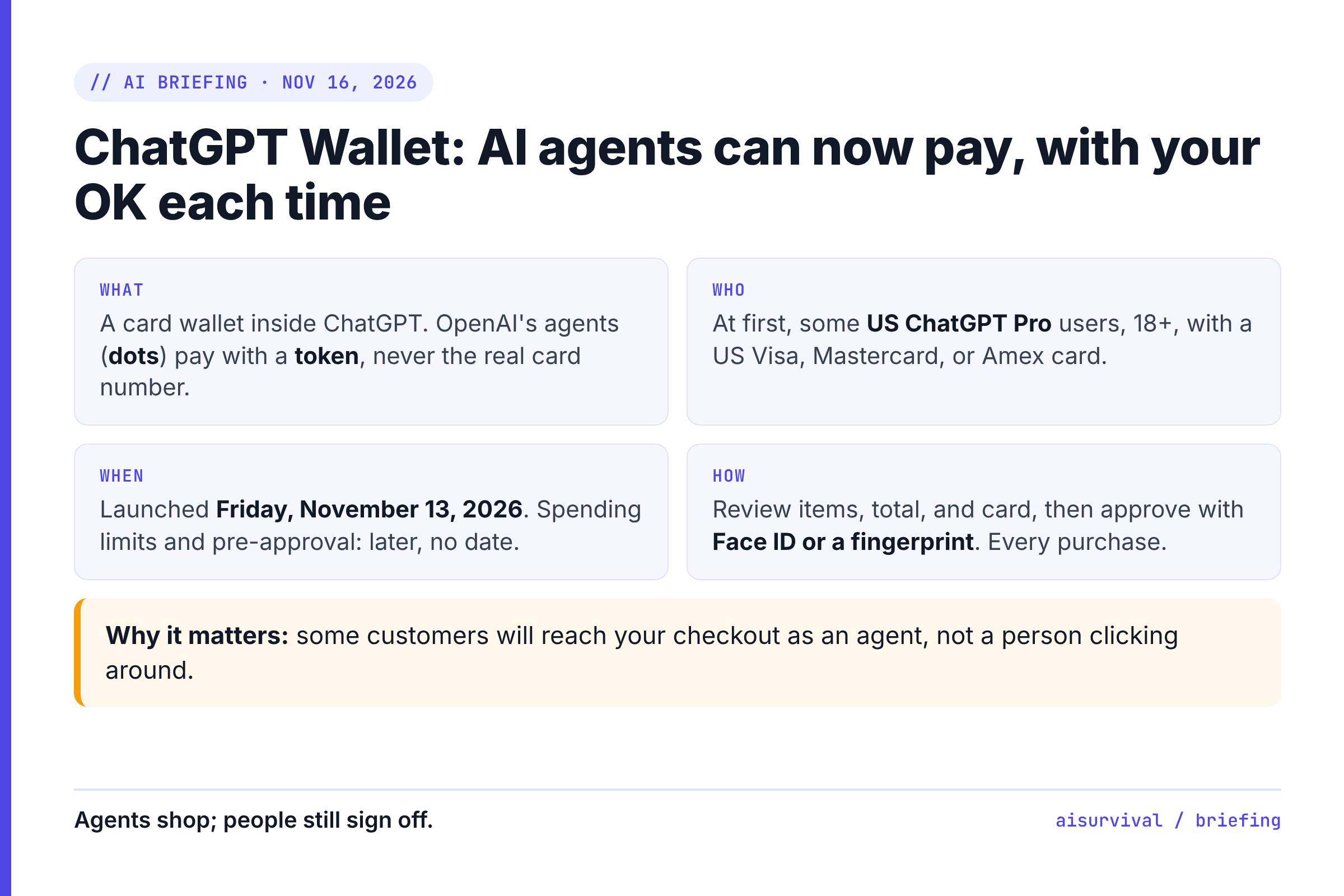
ChatGPT Wallet is a place in ChatGPT where you store a payment card so OpenAI's agents, called dots, can complete purchases for you. The agent never sees your card number. You still approve every single purchase with a security check, such as Face ID or a fingerprint.
Here are the facts, as reported on November 13–16, 2026:
- When: OpenAI launched Wallet on Friday, November 13, 2026 (TechCrunch).
- Who can use it: At first, a small number of US ChatGPT Pro subscribers who are 18 or older and have a US-issued Visa, Mastercard, or American Express card (TechCrunch). The OpenAI community announcement says it starts "through dots for ChatGPT Pro subscribers in the US" (OpenAI Developer Community).
- How a purchase works: You review the items, the total, and the card. Then you pass a security check. Wallet charges the card with a payment token, which is a stand-in for the real card number, so neither the dot nor the merchant sees it (TechCrunch).
- What you keep: Your card's rewards and its dispute protections (TechCrunch; OpenAI Developer Community).
- What sellers get: OpenAI's merchant docs say existing checkout pages should work as they are. Merchants receive a network token, not the full card number, and they still handle the order, shipping, support, and fraud decisions (OpenAI: Agentic commerce in production; OpenAI: Key concepts).
- Not there yet: Spending limits, rules by category or time period, and pre-approved purchases that an agent could finish on its own (TechCrunch).
Why it matters: agents are becoming a type of customer
Everything in this section is our analysis, not something OpenAI said.
Your checkout now has a second kind of visitor
A dot shops in a cloud browser, which is a web browser running on OpenAI's servers rather than on the buyer's laptop. OpenAI's own docs warn that this browser can trip bot detection and risk systems, which may make purchases fail. So the same tools that keep scrapers out may also turn away a real, paying customer.
The human still decides, and that is the design lesson
OpenAI didn't let the agent spend freely. The person sees items, total, and card, then confirms with their face or finger every time. If you're designing any AI feature that touches money, this is a useful reference point: the agent does the legwork, and the person signs off on the final step.
Clear product pages matter more
An agent comparing options can only use what's on the page. If the price, shipping cost, sizes, or stock status hide in images or pop-ups, a person might dig them out, but an agent may simply move on. We expect plain, complete product text to become a quiet advantage.
It's early, so prepare cheaply
Wallet starts with a small group of US Pro users. TechCrunch also notes that DoorDash and Uber have reported low numbers of agent orders, and that some retailers, Amazon the largest among them, block AI agents. Our stance: do the low-cost checks now, and don't rebuild your store around agent shoppers this quarter.
What to prepare for
These are our suggestions, split by who you are.
Product managers and planners
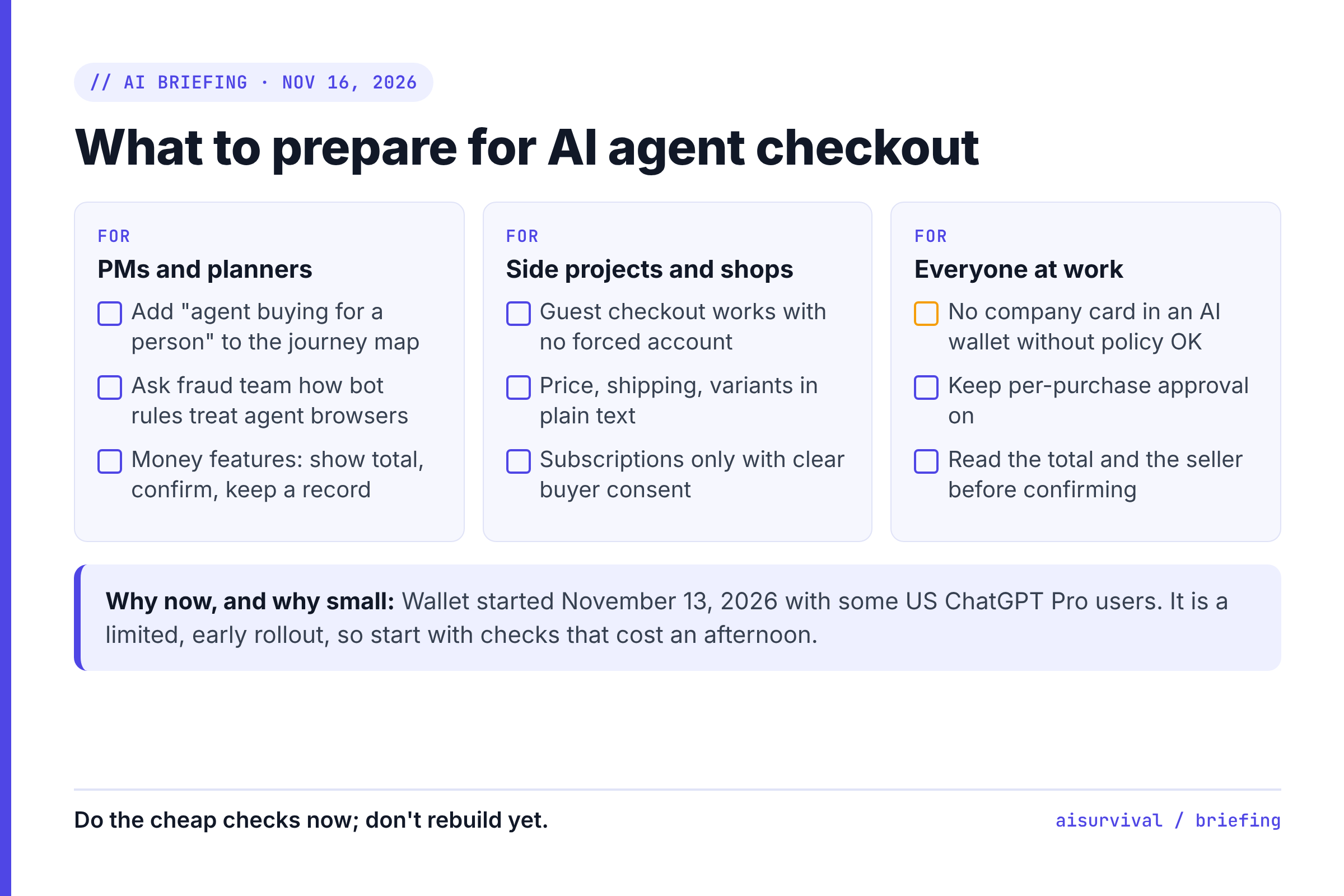
- Add "an agent buying for a person" to your customer journey map, with its own failure points: blocked by bot checks, stuck at a login wall, confused by a missing price.
- Ask your payments or fraud team one question: how would our risk rules treat a purchase from OpenAI's cloud browser? OpenAI says it is starting to pass user signals in the Forwarded HTTP header, a standard way to relay where a request came from.
- If your product has an AI feature that spends money, copy the pattern: show the total, ask for a clear confirmation, keep a record.
People running side projects or small shops
- Check that your checkout works as a guest, without forcing an account first.
- Put price, shipping, variants, and delivery time in plain text on the product page.
- If you sell subscriptions, note OpenAI's rule: recurring charges need a checkout that supports them and the buyer's consent to them.
Everyone using AI at work
- Don't add a company card to any AI wallet until your company's card policy clearly allows it.
- Keep the per-purchase approval on. Read the total and the seller before you confirm.
What we don't know yet
| Question | Why it matters | When we may know |
|---|---|---|
| When will Wallet reach more users and countries? | Decides whether agent buyers are a real share of your traffic. | When OpenAI announces a wider rollout; no date given as of November 16, 2026. |
| When will spending limits and pre-approved purchases arrive? | Pre-approval would let agents buy without a live confirmation, which changes fraud and refund risk. | OpenAI has described these as later features; no date given. |
| How many stores will let agents check out? | An agent is only useful where it isn't blocked. | Watch retailer policies and OpenAI's merchant guidance over the coming months. |
| How will disputes and returns work in practice? | Sellers carry the support and fraud decisions. | After real disputes happen; early reports will tell. |
Copy-and-paste prompt
Use this to check one of your own product pages. Paste the page text, not a link, so the AI reads exactly what an agent would see.
Prompt: Can an AI agent buy from this page?
You are an AI shopping agent buying for a customer.
The customer wants: [what they asked for, e.g., "a gift under $40 that arrives by Friday"]

Here is the full text of my product page:
[paste page text]

Answer in a table: Question | Found on page? | Exact text or "missing"
Check: price, shipping cost, delivery time, sizes or variants, stock status, return policy, whether an account is required.
Then list the top 3 changes that would make this page easier for an agent and a person to buy from.
Quick check
Question: Does a seller need to build a special integration to accept ChatGPT Wallet payments?
Answer: No. OpenAI's merchant docs say "No Wallet-specific integration is required." Your existing checkout should work, but bot protection on your site may still block the agent's browser.
Limits
- This is an analysis of public reports and OpenAI's merchant docs as of November 16, 2026. Rollout details, eligibility, and features may change.
- We could not open OpenAI's main announcement page, so launch details come from TechCrunch, the OpenAI Developer Community post, and OpenAI's developer docs.
- The "Why it matters" and "What to prepare for" sections are our judgment, not OpenAI guidance. We have not tested Wallet ourselves.
- This is not legal, payments, or financial advice. Check card and payment rules with your processor or finance team.
FAQ
Who can use ChatGPT Wallet?
At launch, a small number of US ChatGPT Pro subscribers aged 18 or older with a US-issued Visa, Mastercard, or American Express card. OpenAI calls this an initial rollout.
Can ChatGPT see my credit card number?
According to TechCrunch's report, no: Wallet pays with a token that stands in for the card number. Neither the agent nor the merchant sees the actual number.
Can a ChatGPT agent buy things without asking me?
Not as of November 16, 2026. Each purchase needs your review and a security check, and pre-approved purchases are described as a later feature.
What to read next: if you sell online, clear product text helps people and agents alike, so see AI product description generators compared. To test your checkout with real people, start with usability testing with 5 users.
Your turn: Would you let an AI agent check out for you if you still approved every purchase? Tell us in the comments.
Sources
- TechCrunch: ChatGPT's new Wallet lets AI agents shop and check out for you (Sarah Perez, November 13, 2026)
- OpenAI Developer Community: Introducing ChatGPT Wallet (November 13, 2026)
- OpenAI Developers: Agentic commerce in production (opened November 16, 2026)
- OpenAI Developers: Key concepts (opened November 16, 2026)
Leave a Reply