
How do you estimate rough COGS for a new product?
Add up what one unit costs to make and get to you: materials, making (assembly or a maker’s fee), packaging, landed costs like freight and duties, and a buffer for scrap and surprises. Give each line a low, likely, and high number. Then compare the total with your target cost: target price minus the margin you need. If the high case blows past the target, fix the concept now, while it’s still cheap to change.
Where this sits on the map: Advanced planning track (Y+2 to Y+3) · Feasibility. See the advanced planning hub for the full track.
On this page
- What counts in rough COGS
- Step 1: Start from a target cost
- Steps 2 to 4: Build five lines with ranges
- Step 5: Compare and decide
- Copy-and-paste prompts
- Example (fictional)
- Limits
- FAQ
What counts in a rough COGS estimate?
COGS means cost of goods sold. AccountingTools defines it as “the total of all costs used to create a product or service, which has been sold.” That covers materials, direct labor, freight-in, and factory overhead. It leaves out selling and admin costs like ads, commissions, and office salaries.
Here’s the thing, though. Accountants work out COGS for a whole period, after the sales happen. At the concept stage, you don’t have sales yet. So what you’re really estimating is the cost of one unit, made and delivered to your door, using the same rules about what counts.
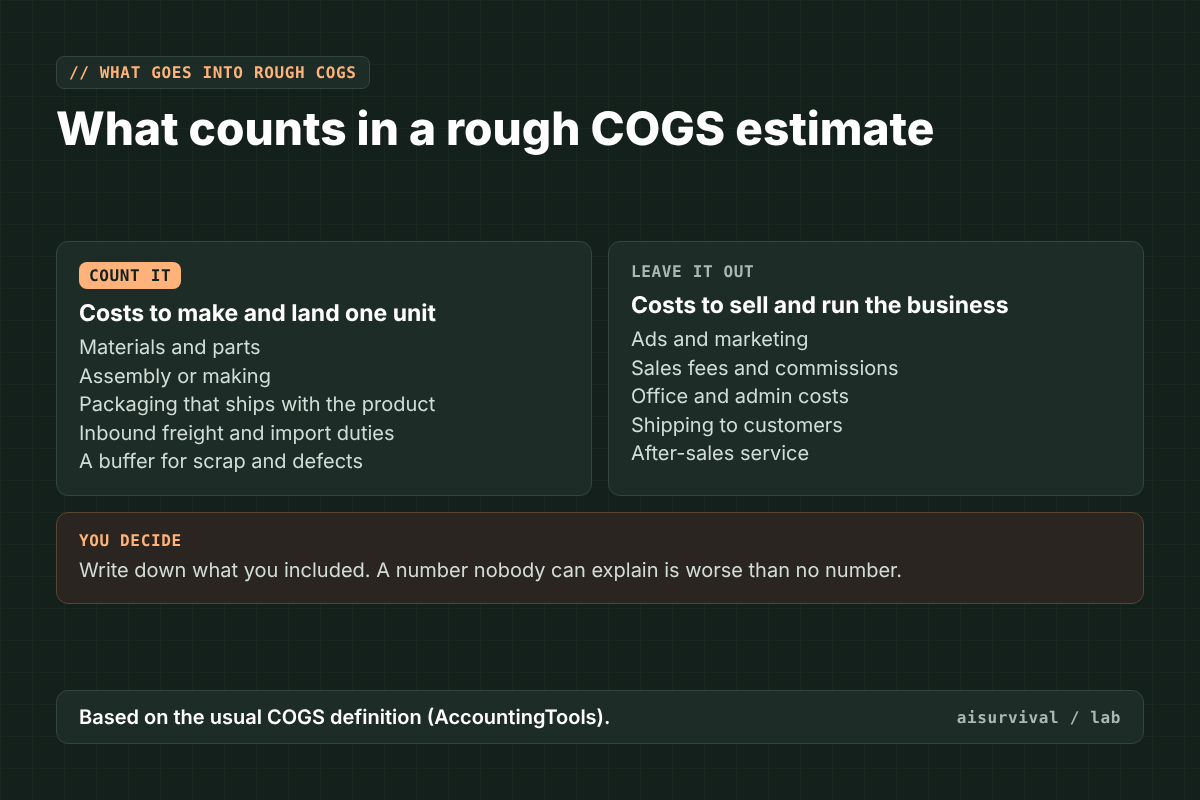
The “delivered to your door” part matters. Freight, import duties, and customs fees to bring goods in are part of the unit cost. This total is often called landed cost. Shipping to your customers is a different story: it’s a selling cost, so it stays out (Finaloop).
Step 1: What is a target cost, and why start there?
A target cost is the most one unit can cost if you still want to hit your margin. The formula is simple: target cost = target price − target profit. The method behind it is called target costing, and its “cardinal rule,” as Wikipedia puts it, “is to never exceed the target cost.”
Why start from the price and not the parts? Because if you add up parts first, you tend to set the price to cover them. Customers don’t care what your parts cost. Starting from the price keeps the question honest: can we make this for that?
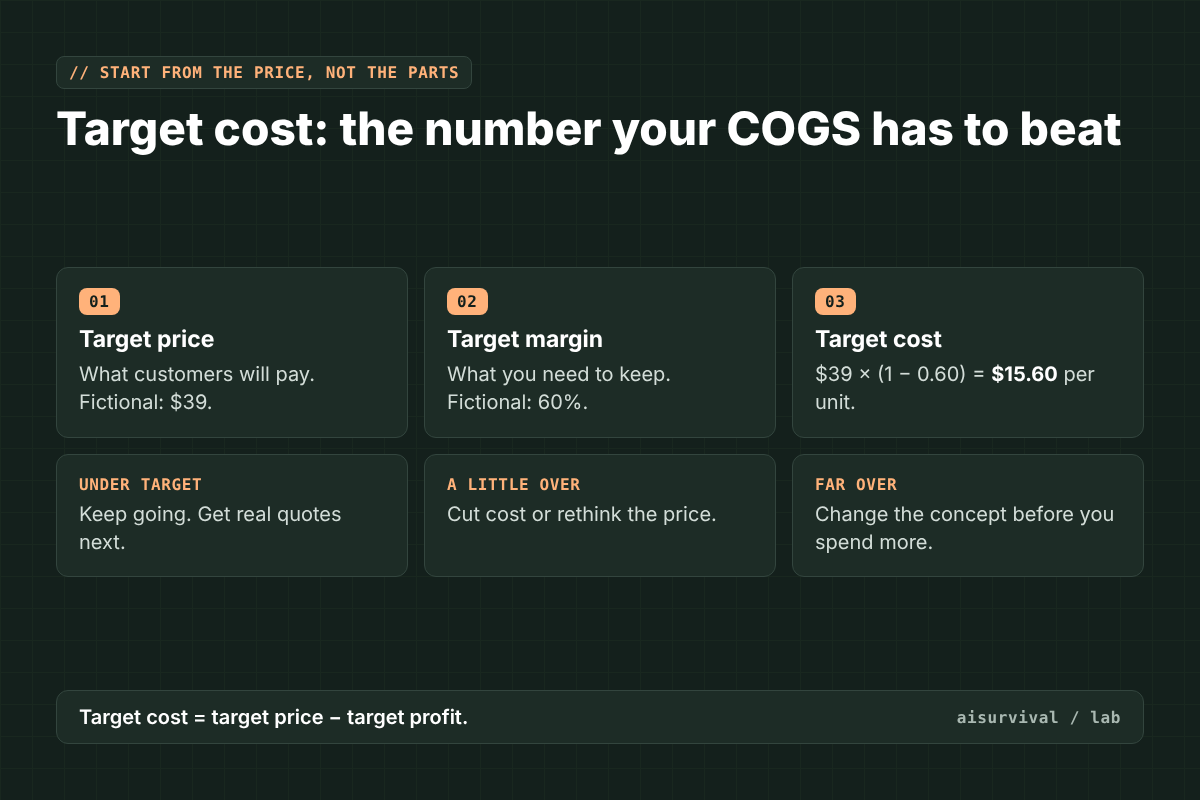
Your target price can come from the 3C analysis (what competitors charge) or your value proposition work (what the benefit is worth). Your target margin is a business choice. Pick one you’d defend in a meeting.
Steps 2 to 4: How do you build the estimate line by line?
Break the unit cost into five lines. For each one, write three numbers: low, likely, and high. Ranges feel less precise, but they’re more honest. A single number at this stage is mostly a guess dressed up as a fact.
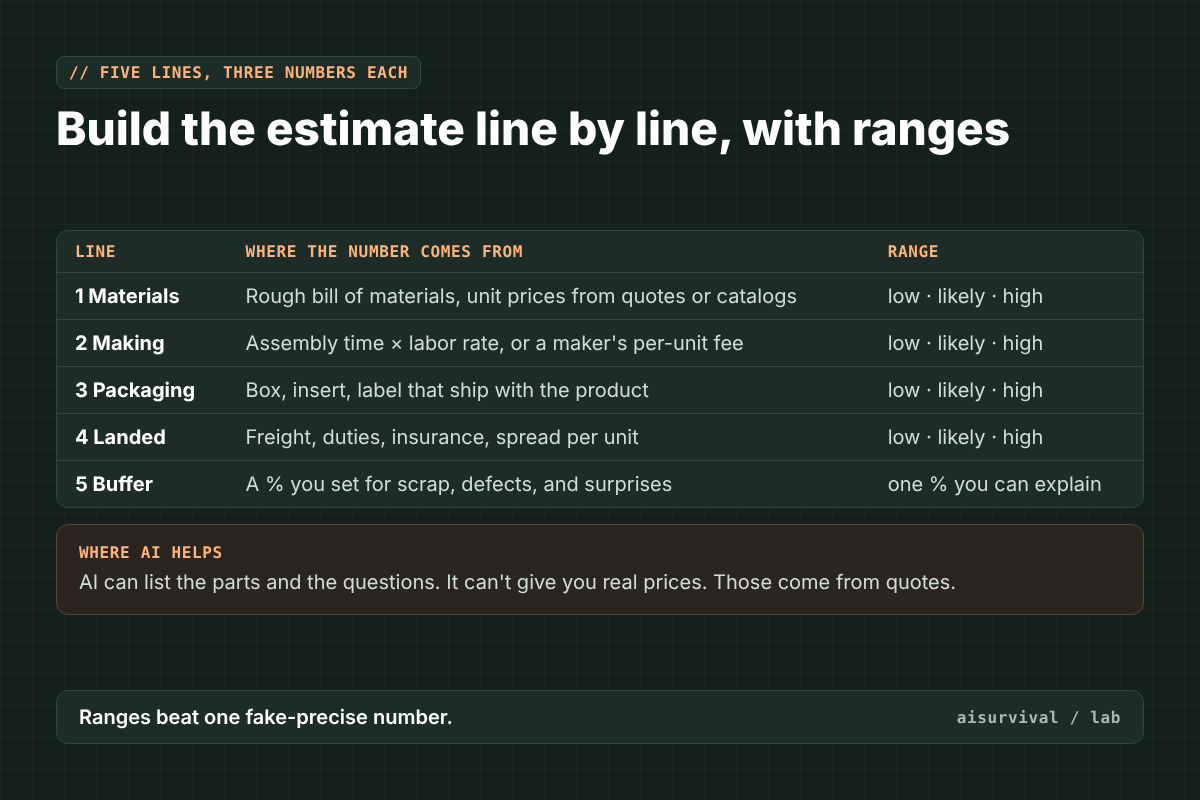
- Materials. Make a rough bill of materials (BOM): every part, how many per unit, and a unit price. Prices come from supplier quotes, catalogs, or a similar product you’ve bought before.
- Making. Either assembly time × labor rate, or a contract maker’s per-unit fee.
- Packaging. Only what ships with the product: the box, insert, and label.
- Landed costs. Inbound freight, duties, and insurance, spread across the units in a shipment.
- Buffer. A percentage you add for scrap, defects, and the stuff nobody thought of. There’s no universal right number. Pick one and write down why.
Large company: cost engineers and procurement build this from real quotes and a detailed BOM, often for several suppliers.
Small seller: a spreadsheet with five rows, two or three supplier quotes, and a sample order. Same logic, smaller scale.
Where AI helps, and where it doesn’t. AI is great at listing the parts you forgot and the questions to ask a supplier. It’s bad at prices. Ask it for a unit price and it’ll happily give you one, with no source behind it. So use AI for the structure and the checklist. Get the numbers from quotes.
Step 5: How do you read the result?
Compare the likely and high totals with your target cost. You’ll land in one of three places:
- Under target, even in the high case. Good. Keep going, and swap your guesses for real quotes.
- Likely fits, high doesn’t. Find the line with the widest range. That’s where your next quote or test should go.
- Over target, even in the likely case. Change something now: a simpler design, a different material, a higher price point, or a different concept.
This connects to the earlier steps in the track. A technology that’s still at a low TRL usually has a wide cost range, too. The TRL and SOP check and the build, buy, or partner choice both feed this estimate.
Copy-and-paste prompts
How to use these:
- Copy a prompt from a gray box below.
- Replace anything in [brackets] with your own details.
- Don’t paste confidential supplier quotes into a public AI tool.
- Run Prompt 1 to build the structure. Fill in real numbers. Then run Prompt 2.
Prompt 1: Build the cost structure (no prices)
Help me build a rough COGS estimate for a new product concept.

Product concept: [one-sentence description]
Main parts or materials I expect: [list]
How it will be made: [in-house / contract maker / unknown]
Where it will be made and where it will be sold: [countries]

1. Make a table with five sections: Materials, Making, Packaging, Landed costs, Buffer.
2. Under each section, list the cost items I should include, and flag any I may have forgotten.
3. Add columns for Low, Likely, High, and Source, but leave all numbers blank.
4. List the questions I should ask a supplier to fill in each blank.
Do not suggest prices, rates, or duty percentages. I will get those from quotes.
Prompt 2: Check the estimate against a target cost
Here is my rough COGS estimate with low, likely, and high numbers:
[paste your filled-in table]

Target price: [price]
Target margin: [percent]

1. Calculate the target cost (price × (1 − margin)) and show the math.
2. Add up the low, likely, and high totals, including the buffer. Show the math.
3. Tell me which case fits under the target and which doesn't.
4. Name the line with the widest range and the line with the biggest share of cost.
5. Suggest three ways to close any gap, and say what each would trade off.
Use only my numbers. If something is missing, say so instead of filling it in.
Tip: AI math can slip. Check the totals in your spreadsheet, not just in the chat.
Example (fictional)
Everything here is made up for illustration.
Back to the lunch box shop from the last few guides. It’s planning an insulated lunch box with the new heat-resistant lid. It wants to sell it online for $39 and keep a 60% margin. So the target cost is $39 × 0.40 = $15.60.
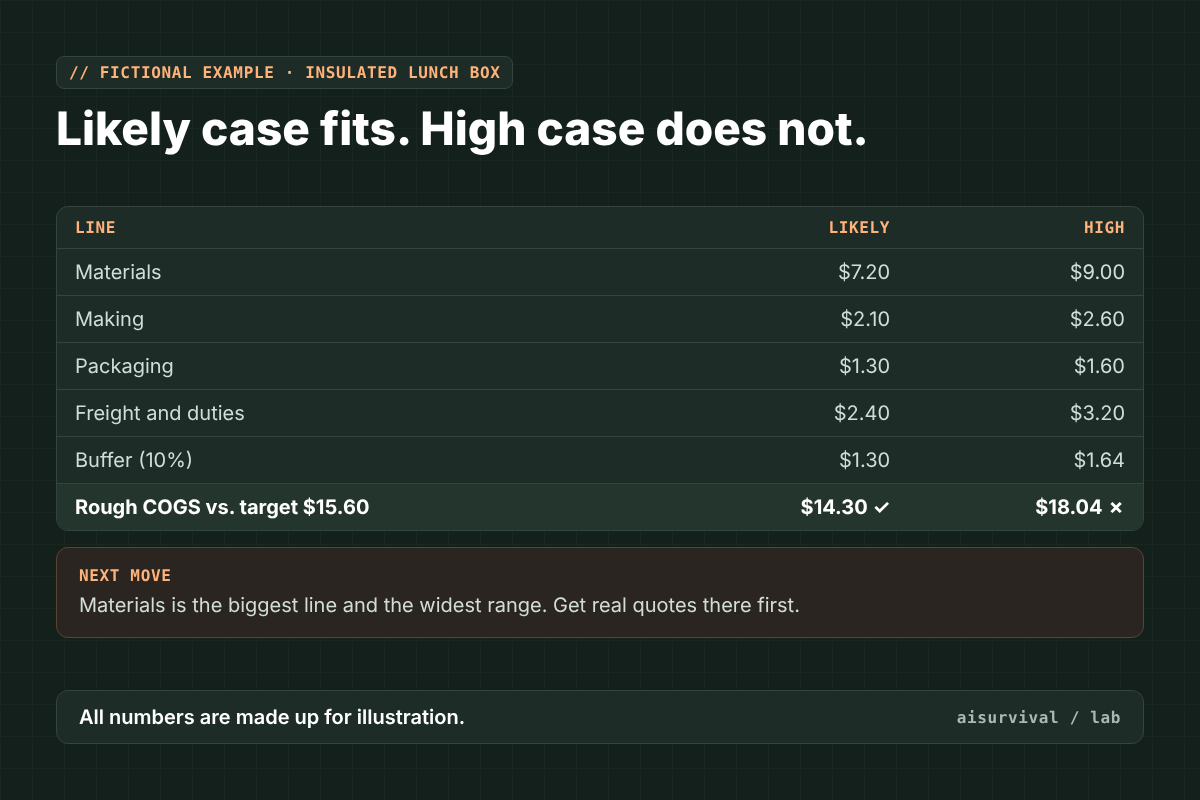
The likely case adds up to $13.00, plus a 10% buffer of $1.30, for $14.30. That fits. The high case is $16.40 plus $1.64, for $18.04. That doesn’t. Materials is both the biggest line and the widest range, so the shop’s next move is clear: get two real quotes for the body and lid before doing anything else.
Quick checklist:
☐ You started from a target price and margin.
☐ Every line has low, likely, and high numbers.
☐ Every number has a source, or is marked as a guess.
☐ Selling costs (ads, fees, shipping to customers) are left out.
☐ You know which line to quote first.
Limits
- This is a planning estimate, not accounting or tax advice. How COGS is reported on your books depends on your accounting method. Ask an accountant.
- Unit costs often change with order size. A rough estimate at one volume won’t hold at another.
- Duty rates and freight costs change. Check current rates for your product and route.
- The lunch box example and all its numbers are fictional.
FAQ
What is included in COGS?
The costs to make the product and get it ready to sell: materials, direct labor, inbound freight, and factory overhead. Selling and admin costs, like ads, commissions, and office costs, aren’t included.
Is shipping to customers part of COGS?
Not in a landed cost estimate. Freight to bring goods in counts. Shipping to customers is usually treated as a selling cost. How you report it on your books is a question for your accountant.
What is the difference between COGS and target cost?
Rough COGS is what you think a unit will cost. Target cost is what a unit can cost if you want to hit your margin at your price. You want the first to land under the second.
Can AI estimate product costs for me?
It can build the structure, flag missing items, and do the math with your numbers. It shouldn’t supply the prices. Those need to come from quotes, catalogs, or your own past orders.
Where this fits: Advanced planning track · Feasibility, part of the product management process guide. Previous: Build, Buy, or Partner? PoC and Joint Development Explained
Next in this track: concept testing with AI, how to write the survey and read the results before you build anything. Subscribe if you’d like it in your inbox.
Your turn: Which cost line is hardest for you to estimate early? Tell us in the comments. Your answers shape future guides.