
QUICK ANSWER
TRL (technology readiness level) tells you how mature a technology is, on a scale from 1 (research is just starting) to 9 (proven in real use). SOP (start of production) is the date mass production begins. You need both. A technology can work as a prototype and still not be ready to make in volume, and a supplier’s SOP date only matters if it lands before the date you need parts. Ask for the TRL with evidence, ask what’s left between today and SOP, and put that SOP on your own timeline with a buffer.
Where this sits on the map: Advanced planning track (Y+2 to Y+3) · Technology sourcing. See the advanced planning hub for the full track.
On this page
- TRL in plain words
- SOP, and what comes before it
- Why TRL alone isn’t enough
- A readiness check in three questions
- Copy-and-paste prompts
- Example (fictional)
- Limits
- FAQ
TRL in plain words
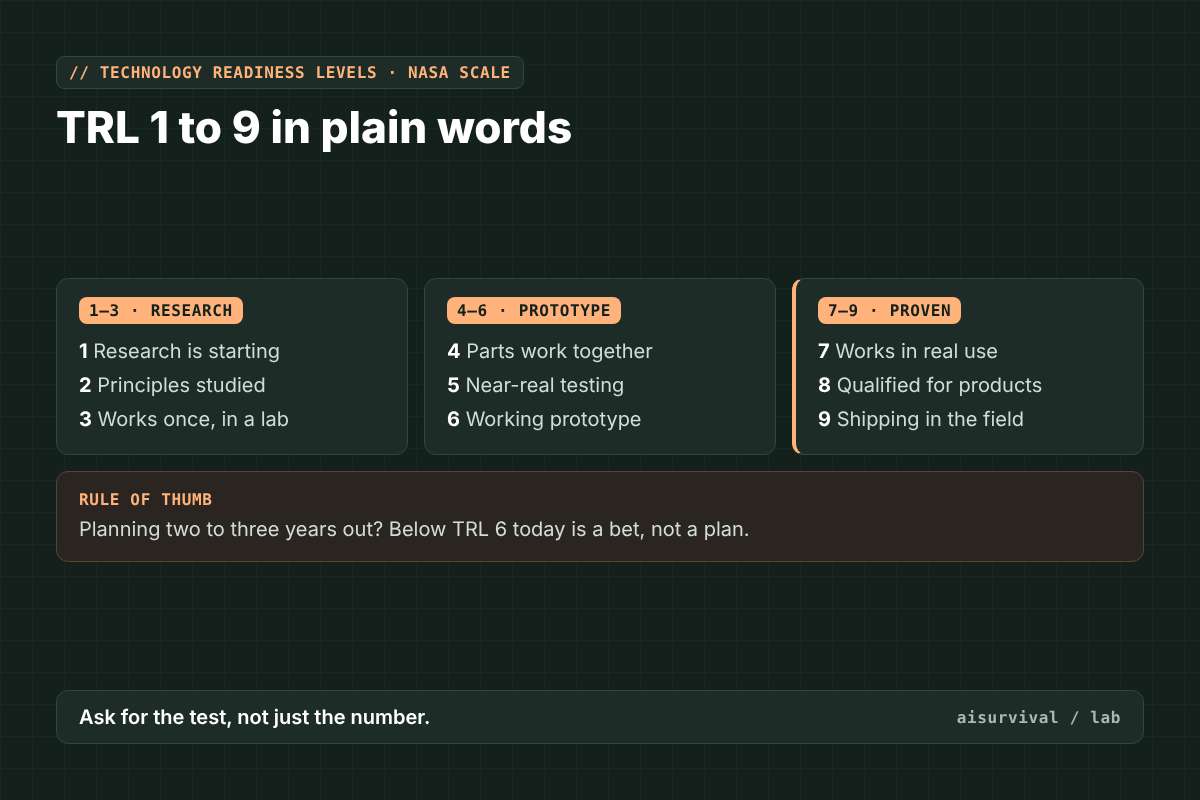
NASA describes technology readiness levels as “a type of measurement system used to assess the maturity level of a particular technology.” There are nine levels. TRL 1 is the lowest and TRL 9 is the highest (NASA).
NASA’s wording is written for spacecraft, so here’s a plain version. The left column follows NASA’s definitions. The right column is how a product planner can read each level for a consumer product.
| Level | NASA (short) | How to read it for a product |
|---|---|---|
| TRL 1 | Scientific research is beginning | An idea in a paper. Nothing you can touch. |
| TRL 2 | Basic principles have been studied | People can imagine uses, but there’s little proof. |
| TRL 3 | Analytical and lab studies, proof of concept | It works once, in a lab, under ideal conditions. |
| TRL 4 | Component pieces tested together | Parts work together on a bench. |
| TRL 5 | Breadboard, tested in near-realistic conditions | A rough version survives conditions close to real use. |
| TRL 6 | Fully functional prototype | A working prototype that looks like a real part. |
| TRL 7 | Demonstrated in the real operating environment | The prototype works where it will actually be used. |
| TRL 8 | Qualified, ready to integrate | Tested and approved to go into a real product. |
| TRL 9 | Proven in real use | Already shipping and working in the field. |
A rough way to group them: 1 to 3 is research, 4 to 6 is prototype, 7 to 9 is proven. For a product two or three years out, anything below 6 today is a bet, not a plan.
SOP, and what comes before it
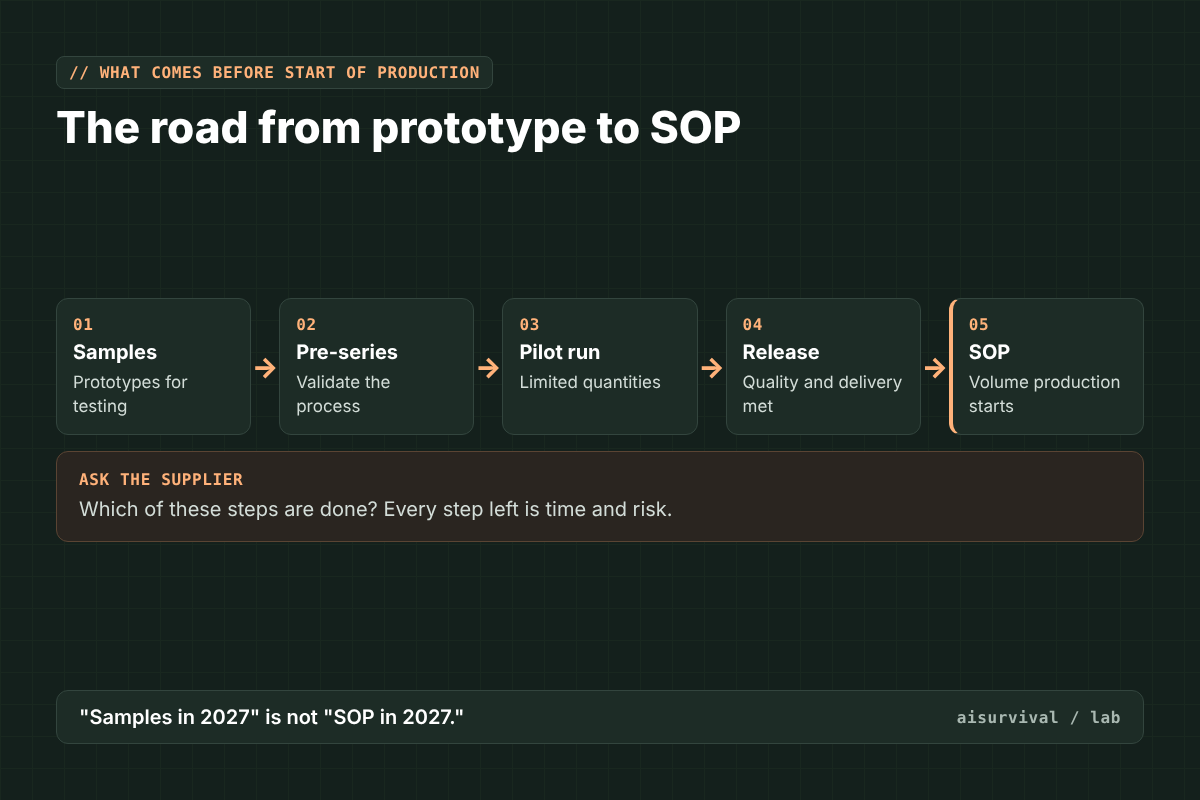
SOP stands for start of production. One procurement glossary defines it as “the controlled transition from development to serial production” (Tacto). In plain words: the day the factory starts making the part in volume.
SOP rarely comes straight after a prototype. The same glossary describes the steps on the way: prototype samples for testing, pre-series production to validate the process, a pilot run with limited quantities, and a production release that only happens after quality and delivery criteria are met. After SOP comes the ramp-up to full volume.
That’s why the supplier roadmap guide said to ask which milestone a date means. “Samples in 2027” and “SOP in 2027” can be a year apart.
Why TRL alone isn’t enough
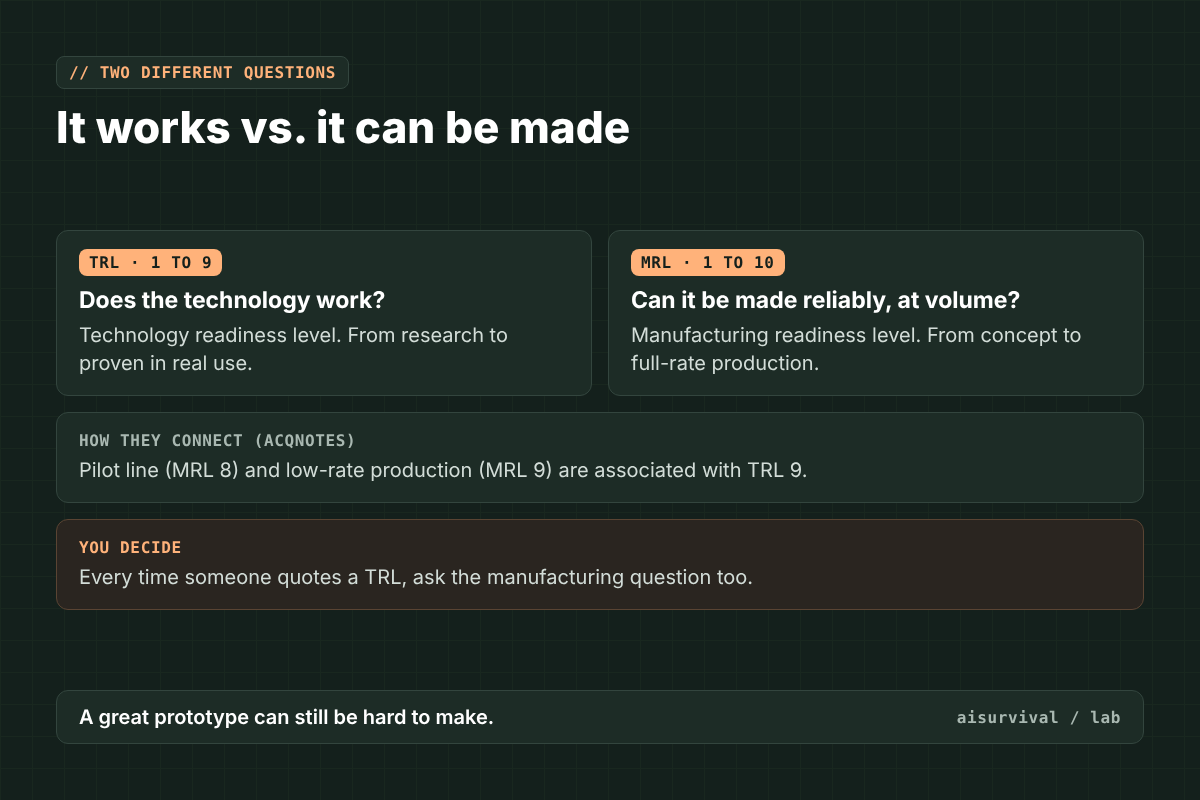
TRL answers one question: does the technology work? It doesn’t answer the second one: can someone make it reliably, at your volume and cost?
Defense programs track that second question with a separate scale, the manufacturing readiness level (MRL), which runs from 1 to 10. According to AcqNotes, MRL 8 means pilot line capability has been demonstrated, MRL 9 means low-rate production has been demonstrated, and both are associated with TRL 9. It also notes that manufacturing readiness is often held back by technology readiness or design stability.
You don’t need to score MRL formally. Just ask the manufacturing question every time someone quotes you a TRL.
A readiness check in three questions
- What’s the TRL today, and what’s the evidence? Ask for the test, not the number. “TRL 6” with no test report is a guess.
- What’s left before SOP? Ask which steps are done: samples, pre-series, pilot run, production release. Every step not done yet is time and risk.
- Does SOP land before your parts-needed date? Put it on your own timeline, with a buffer that grows the lower the TRL is.
Large company: a readiness review with R&D, quality, and procurement, using supplier test reports and audit results.
Small seller: three emails to your factory or vendor with these questions, and one line per answer in a sheet.
Copy-and-paste prompts
How to use these:
- Collect what the supplier told you: claims, test results, dates. Remove names and anything confidential.
- Run Prompt 1 to sort claims from evidence.
- Send the follow-up questions it suggests.
- Run Prompt 2 with your launch date to see how much buffer you have.
Tip: AI can sort evidence. It can’t tell you the real TRL. Only test results can.
Prompt 1: Separate claims from evidence
Below is what a supplier told me about a new technology. Names and confidential details are removed.

[paste notes, claims, and any test results]

1. List every claim about maturity (for example "ready", "proven", "TRL 6").
2. For each claim, say whether my notes include evidence: a test, a report, a shipping product. Write EVIDENCE or NO EVIDENCE.
3. Based only on the evidence, give a TRL range (for example 4 to 5) and explain it using the plain definitions: research (1-3), prototype (4-6), proven (7-9).
4. List what is still missing before start of production: samples, pre-series, pilot run, production release.
5. Write 3 follow-up questions for the supplier.

Do not assume anything that is not in my notes.
Prompt 2: Work backward from launch
My launch date: [month, year]
Time I need between final parts and launch (testing, certification, stock): [months]
Supplier's SOP date: [month, year]
TRL today, based on evidence: [range]

1. Calculate the date I need final parts.
2. Compare it with the SOP date and say ON TIME, TIGHT (under 3 months of margin), or LATE.
3. Suggest a buffer: more months for lower TRL. Explain the reasoning in one sentence.
4. If TIGHT or LATE, suggest one plan B.

Do not change any date I gave you.
Example (fictional)
Everything here is made up for illustration.
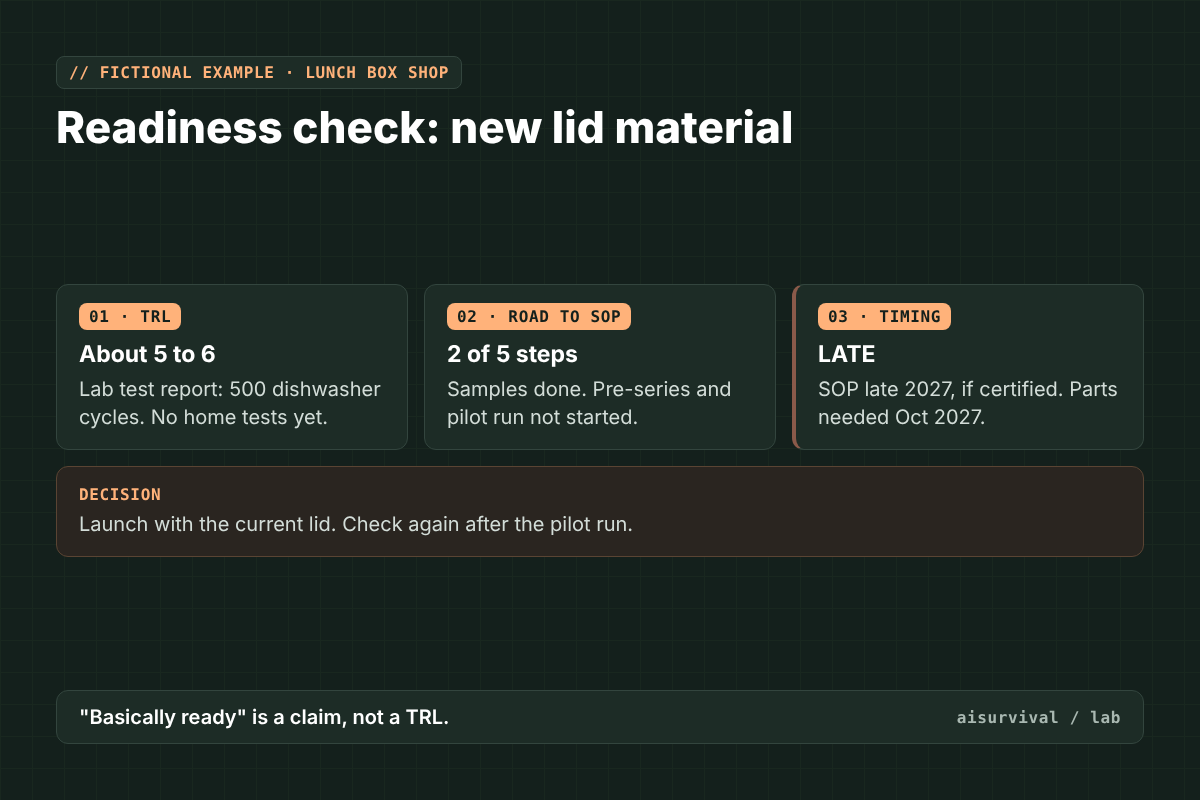
Back to the lunch box shop from the supplier roadmap guide and its new heat-resistant lid material. After Prompt 1, the shop sorts what it heard:
| Claim | Evidence? | Read as |
|---|---|---|
| “The material is basically ready.” | No | Not a TRL. Ask for tests. |
| Prototype lids passed 500 dishwasher cycles in the supplier’s lab. | Yes, test report | About TRL 5 to 6 |
| No tests in home dishwashers yet. | — | Not TRL 7 yet |
| Pilot run planned for mid-2027. | Date only | Pre-series and pilot not done |
| SOP “late 2027, if certification passes.” | Date with a condition | Treat as planned, not committed |
Prompt 2 with a spring 2028 launch shows the shop needs parts by October 2027. SOP lands at or after that date, with a prototype-level TRL and an open certification. Verdict: LATE for the first launch. Same decision as before, now with a clearer reason: launch with the current lid, and check again after the pilot run.
Quick checklist:
☐ Every TRL claim has a test behind it.
☐ You know which steps before SOP are done.
☐ You asked the manufacturing question, not just “does it work?”
☐ SOP sits on your timeline, before your parts-needed date.
☐ The buffer is bigger when the TRL is lower.
☐ Nothing confidential went into a public AI tool.
Limits
- TRL was built for space and defense programs. Using it for consumer products is a rough guide, not a standard.
- Suppliers often report their own TRL. Without test evidence, treat it as a claim.
- The “below 6 is a bet” rule and the buffer advice are rules of thumb, not industry requirements.
- This isn’t engineering, quality, or legal advice. Follow your company’s own gate reviews and your NDA.
FAQ
What are the 9 technology readiness levels?
They run from TRL 1, where scientific research is beginning, to TRL 9, where the technology is proven in real use. In between: concept, lab proof, components tested together, realistic testing, prototype, real-environment demo, and qualification.
What does SOP mean in manufacturing?
Start of production: the move from development to serial production. It usually comes after samples, pre-series production, a pilot run, and a production release.
What’s the difference between TRL and MRL?
TRL measures whether the technology works. MRL, the manufacturing readiness level, measures whether it can be made reliably at volume. A technology can have a high TRL and still not be ready to manufacture.
What TRL should a technology have before I plan a product around it?
There’s no single rule. As a rough guide for a launch two to three years out, a working prototype (around TRL 6) with a clear path to production is a reasonable floor. Below that, plan a backup.
Where this fits: Advanced planning track · Technology sourcing, part of the product planning process series. Previous guide in this track: how to read a supplier technology roadmap.
Next in this track: Build, Buy, or Partner? PoC and Joint Development Explained.
Your turn: Has a supplier ever called something “ready” that wasn’t? Tell us in the comments. Your answers shape future guides.