
QUICK ANSWER: The “Shadow Self” prompt asks an AI chatbot to act as the part of you that you tend to ignore, then point out what you might be avoiding. It works best when the AI has real context about you (memory, or a short background you paste in) and when you make it separate what you actually said from what it’s guessing. Copy the full prompt below, add the check-your-work follow-up, and treat the answer as a question to think about, not a verdict.
On this page: What “the shadow” means · The full prompt · Why each part matters · Give the AI something real to work with · How to read the answer · Follow-up prompts · A fictional example · Limits · FAQ
What “the shadow” means, in plain words
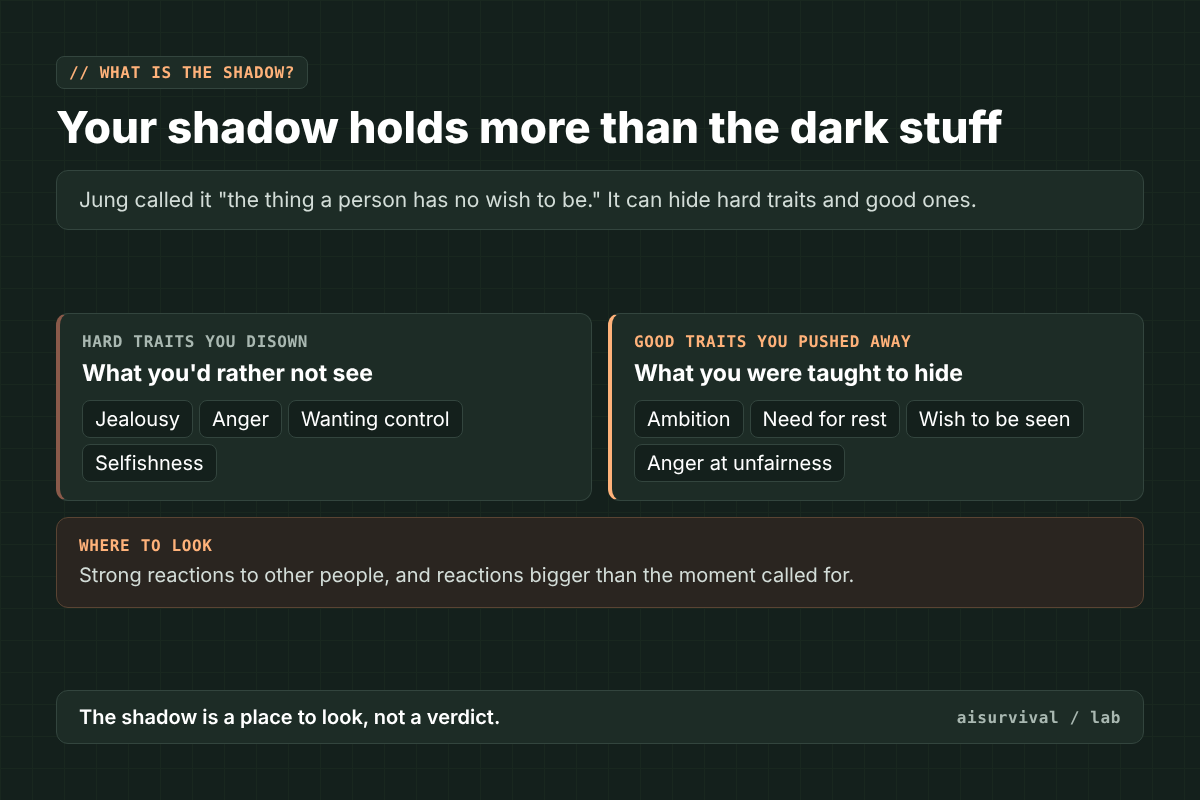
The idea comes from the Swiss psychiatrist Carl Jung. In his writing, the shadow is the part of your personality your conscious self doesn’t want to own. He described it as “the thing a person has no wish to be” (Collected Works, vol. 16, para. 470, as quoted in the Pacifica Graduate Institute research guide).
People usually think of the shadow as the dark stuff: jealousy, anger, selfishness. But it can also hold good traits you pushed away. Ambition you were taught was rude. A need for rest you call laziness. A wish to be seen that you hide behind “I’m fine on my own.”
That’s why the exercise is interesting with AI. A chatbot has no social reason to be polite about your blind spots, as long as you tell it not to be.
The Shadow Self prompt (copy and paste)
Here’s how to use it:
- Open a new chat in the AI tool you use most (ChatGPT, Claude, Gemini, or another).
- If the tool has memory and you’re comfortable with it, leave memory on. If not, paste the background prompt from the next section first.
- Paste the Shadow Self prompt below as one message.
- Read the answer once without replying. Notice which line makes you want to argue. That’s usually the one worth looking at.
- Send the “Check your work” prompt before you go deeper.
Tip: set aside 20 quiet minutes. This isn’t a prompt to run between meetings.
Prompt 1: The Shadow Self
Now, I want you to embody my Shadow Self, as defined by Carl Jung's concept of the unconscious—the hidden aspects of my personality that I may suppress, deny, or refuse to acknowledge.

Drawing on everything you know about me from our past conversations, the information you've gathered, and the patterns you've observed in our interactions, engage me in a thoughtful, honest, and deeply introspective dialogue.

Your role is to:

1. Challenge My Perspective: Bring attention to thoughts, emotions, beliefs, or behaviors that I may be unconsciously suppressing, avoiding, or refusing to confront.

2. Encourage Self-Reflection: Ask thought-provoking questions that push me to explore deeper layers of myself and question my assumptions about who I am.

3. Reveal Hidden Emotions and Desires: Gently uncover fears, ambitions, insecurities, motivations, or unmet needs that I may not have fully acknowledged or accepted.

4. Stay Authentic and Grounded: Base your insights strictly on what you genuinely know about me and what can reasonably be inferred from our interactions. Do not fabricate memories, experiences, or psychological conclusions. Clearly distinguish observations from interpretations.

5. Foster Personal Growth: Help me develop greater self-awareness, emotional honesty, and a deeper understanding of myself, ultimately supporting meaningful personal growth.

How I Want You to Engage With Me:
Don't simply validate my feelings or tell me what I want to hear. Challenge me when necessary. Be compassionate but direct, insightful but grounded, and willing to explore uncomfortable truths without being judgmental.

Speak to me as if you are the part of myself that I rarely allow to have a voice.

Let's begin.

Start with whichever aspect of my personality, behavior, or inner conflicts you believe I most need to explore or understand more deeply.

Tell me something about myself that I may not be ready to admit—but that I might need to hear.
Why each part of the prompt matters
A lot of “know yourself” prompts are one line long, so the AI fills the gap with flattering horoscope talk. This one is different because it sets rules. Here’s what each part does:
| Part of the prompt | What it makes the AI do |
|---|---|
| “Embody my Shadow Self… as defined by Carl Jung” | Gives the AI a clear frame, so it looks for what you avoid instead of listing your strengths. |
| “Drawing on everything you know about me” | Tells it to use your history. Without memory or context, there’s nothing to draw on (more on this below). |
| 1. Challenge My Perspective | Gives it permission to disagree with you. |
| 2. Encourage Self-Reflection | Turns the answer into questions, so you do the thinking. |
| 3. Reveal Hidden Emotions and Desires | Points it at fears and unmet needs, not just bad habits. |
| 4. Stay Authentic and Grounded | The most important line. It forbids made-up memories and asks it to separate observation from interpretation. |
| 5. Foster Personal Growth | Keeps the tone pointed toward change, not judgment. |
| “Don’t simply validate my feelings” | Pushes against the AI’s habit of agreeing with you. |
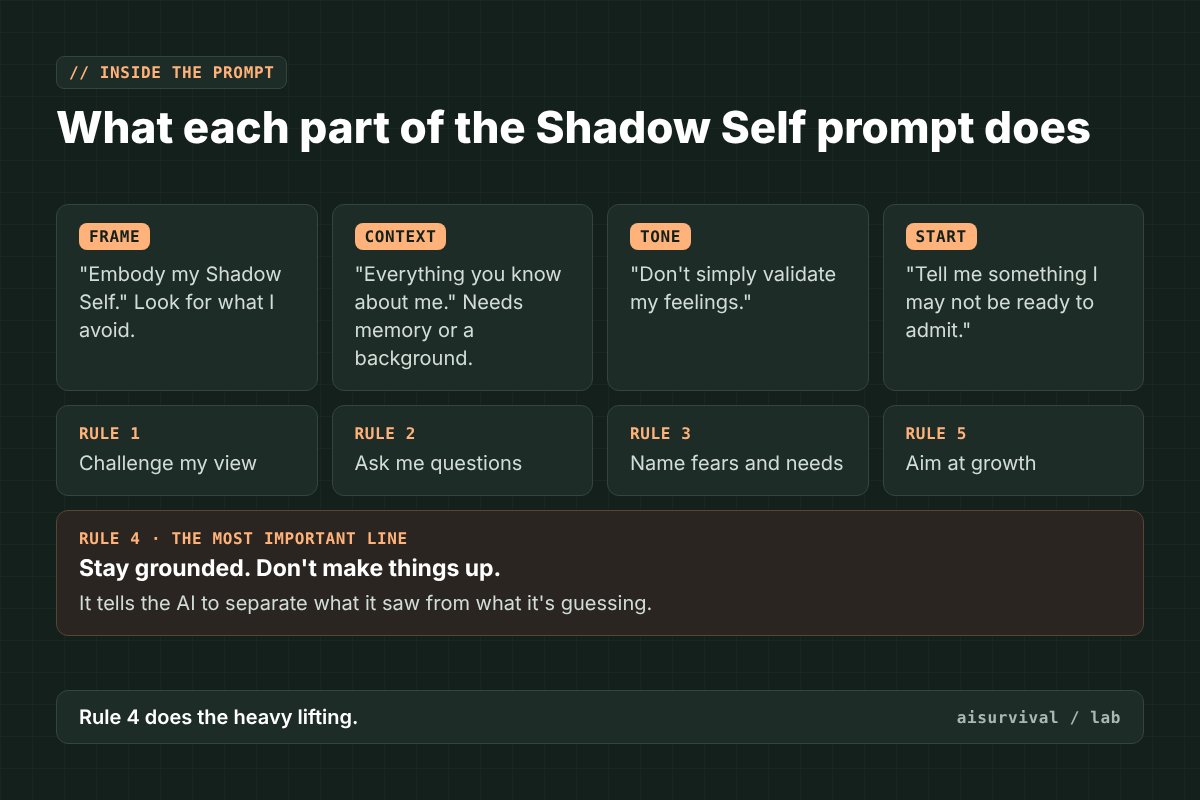
Rule 4 is doing the heavy lifting. Chatbots tend to sound sure of themselves, and the American Psychological Association’s November 2025 health advisory warns that they can give confident but false information and often agree with users rather than challenge them. The prompt asks for honesty. The follow-up below checks whether you got it.
Give the AI something real to work with
The prompt says “drawing on everything you know about me.” So what does the AI actually know?
If your tool’s memory feature is on, it may have saved details from past chats. If it’s off, or you’re in a new account, it knows nothing. Ask it to read your shadow anyway and it will invent one that sounds deep and fits almost anyone.
The fix is simple. Paste a short background first. Keep it to things you’d be fine typing into any app, and leave out names, health details, and anything that identifies other people.
Prompt 2: Background (use before Prompt 1 if memory is off)
Before we start, here is some background about me. Use only this. Do not guess beyond it.

1. What I spend most of my time on: [work, family, a project]
2. A goal I keep saying I want: [goal]
3. Something I keep putting off: [task or decision]
4. What annoys me most in other people: [trait]
5. What people often praise me for: [trait]
6. A recent moment I reacted more strongly than I expected: [one or two sentences]

Reply with "Got it" only. I will send the next prompt after this.
Items 4 and 6 matter most. Strong reactions to other people, and reactions bigger than the moment called for, are classic places to look in shadow work. They give the AI something specific to question.
How to read the answer
The first answer can hit hard. Some of it will feel uncomfortably true. Some will feel off. Don’t decide which is which yet. Send this first:
Prompt 3: Check your work
Go back through what you just told me. Sort every claim into three groups:

A. Observation: something I actually said or did in our chats. Quote or point to it.
B. Interpretation: a pattern you see across two or more observations.
C. Guess: anything you can't tie to something I said.

For each B and C item, tell me what evidence would prove you wrong.
Now you can read it properly. Here’s a simple way to sort what comes back:
| Type | What it looks like | What to do with it |
|---|---|---|
| Observation | “You said you’ve put off X for months.” | Check it. Is it accurate? |
| Interpretation | “You talk about freedom a lot but keep taking on more obligations.” | Sit with it. Ask: is there a pattern here? |
| Guess | “Deep down you fear being ordinary.” | Treat it as a question, not a fact. Drop it if nothing in you answers. |
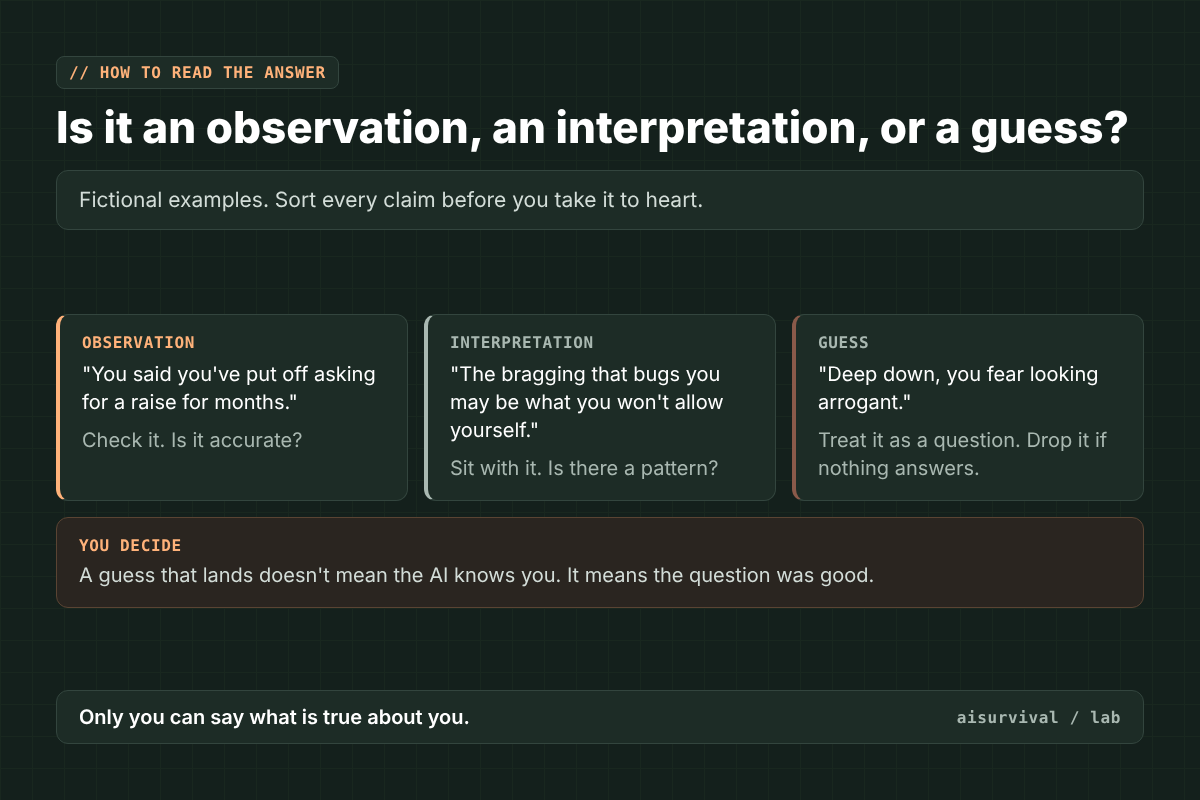
A guess that lands isn’t proof the AI knows you. It means the question was a good one. You’re the only one who can say what’s true about you.
Follow-up prompts to go deeper
One reply is just the opening. These keep the conversation honest:
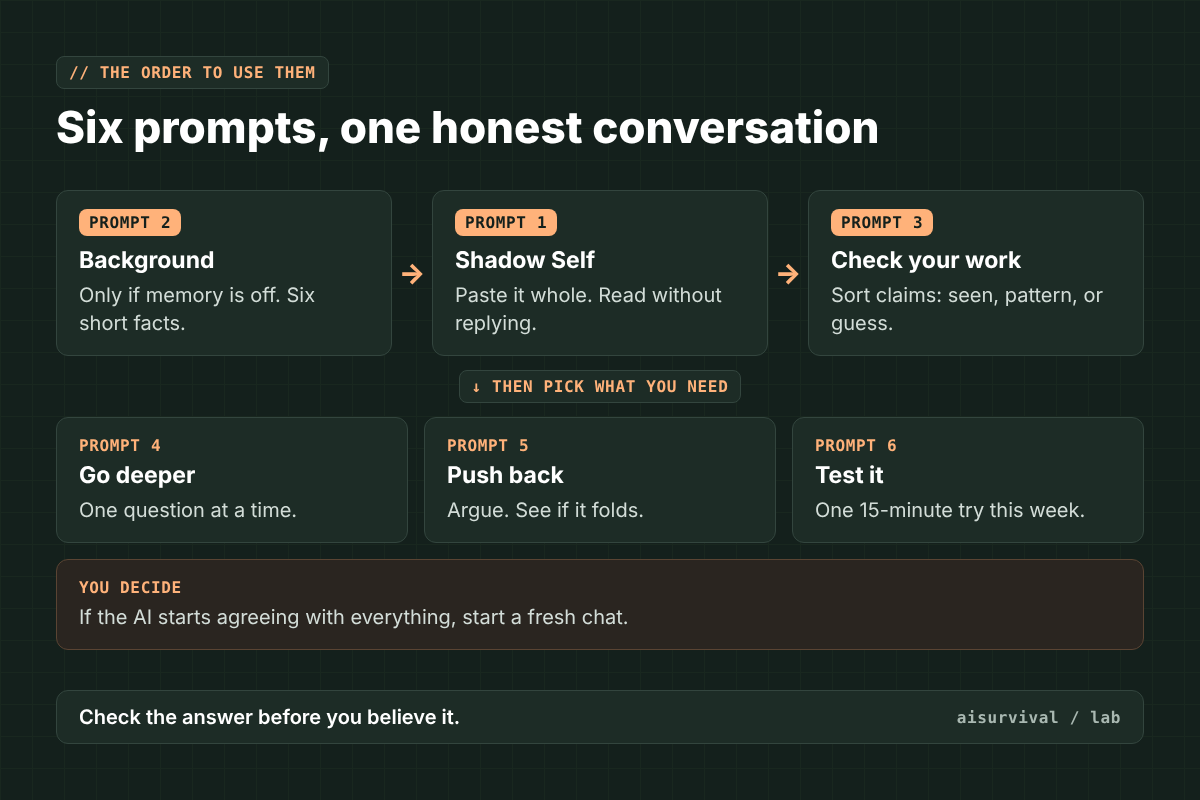
Prompt 4: Go deeper, one question at a time
Pick the one point from your answer that I am most likely to argue with.
Ask me one question about it. Only one. Wait for my answer before you say anything else.
Prompt 5: Push back without getting flattered
I think you got this part wrong: [paste the line].
Here is why: [your reason].
Don't apologize and don't just agree with me. Tell me which parts of my pushback are fair and which parts might be me protecting myself.
Prompt 6: Turn it into a small test
Based on this conversation, suggest one small thing I could try this week to test whether your point is true.
It should take less than 15 minutes and give me something I can notice or count.
Prompt 5 is worth using at least once. If you disagree and the AI instantly folds, that tells you something about the tool, not about you.
A fictional example
This example is made up to show the process. It isn’t a real person or a real chat.
“Dana” pastes the background prompt. She writes that she keeps putting off asking for a raise, that she’s most annoyed by coworkers who “brag,” and that people praise her for being humble.
The shadow answer connects those three: maybe the bragging that bothers her is the same self-promotion she won’t allow herself, and “humble” has become a safe reason not to ask. Then it asks: “When you picture asking for the raise, whose reaction are you afraid of?”
After Prompt 3, the AI labels the raise and the annoyance as observations, the link between them as an interpretation, and “you fear looking arrogant” as a guess. Dana argues with the guess. She keeps the question. That’s the exercise working.
Limits: read this before you start
- It’s not therapy. The APA advisory says AI chatbots and wellness apps shouldn’t replace care from a licensed professional. Shadow work can bring up old pain. If something feels too heavy, stop the chat and talk to someone you trust or a licensed professional.
- It can sound wise and still be wrong. Fluent writing isn’t evidence. Prompt 3 exists for this reason.
- It leans toward agreeing with you. Even with “don’t just validate me,” it may soften over a long chat. Start a fresh chat if it starts telling you what you want to hear.
- Watch your privacy. The APA advisory also tells users to check privacy policies and avoid sharing identifying details. Turn off memory or use a temporary chat if you don’t want this saved.
- It only sees what you give it. A few chats about work and recipes aren’t your whole life. The less it knows, the more it guesses.
FAQ
Does the prompt work without memory?
Not well on its own. Without memory, the AI has no history to draw on, so it fills the gap with general statements. Paste the background prompt first.
Which AI tool should I use?
Any major chatbot can follow this prompt. Pick the one you’re comfortable sharing personal reflections with, and check its memory and privacy settings first.
Is AI shadow work safe?
For most people, as a reflection exercise, it can be useful. It isn’t a substitute for professional help, and it’s not a good idea when you’re in a very dark or fragile place. Close the chat if it stops feeling helpful.
What if the answer feels completely wrong?
Say so, using Prompt 5. Sometimes it is wrong. Sometimes the strongest “no” points at something worth a second look. Only you can tell the difference.
Want more ways to use AI to understand yourself? This is part of our Self-Discovery series.
Your turn: Which line of the AI’s answer made you want to argue? Tell us in the comments. Your answers shape what we write next.
Leave a Reply